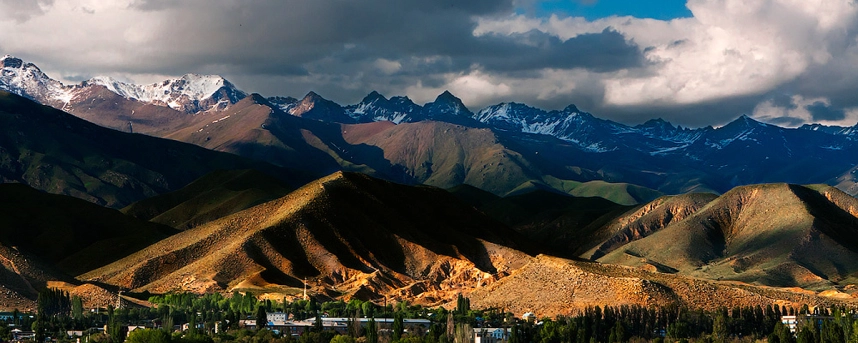
Issyk-Kul is the largest lake in Kyrgyzstan and one of the country’s top destinations for road trips. Stretching for about 180 km, the lake never freezes in winter thanks to its depth, slight salinity, and warm springs. The region is also part of a UNESCO Biosphere Reserve. This makes it an especially convenient route for a self-drive trip: the northern shore is better suited for beach отдых, hotels, and restaurants, while the southern shore is known for canyons, wild beaches, and peaceful panoramic views.

The best format for a trip around Issyk-Kul is 4 days: that gives you enough time to see the southern shore, Karakol, Jety-Oguz Gorge, hot springs, and the northern shore with Cholpon-Ata without rushing. In 3 days, the itinerary will be more intensive, while 5 days allows for longer beach stops and extra detours into the gorges. This is not an official standard, but a practical route based on the most popular stops around the lake.
Why It Is Better to Drive Around Issyk-Kul by Car
A trip around the lake is possible without a car, but driving gives you the main advantage — freedom of pace. In one journey, you can combine a historical stop at Burana Tower, a sunset on the southern shore, a walk through Fairy Tale Canyon, lunch in Karakol, a dip in the Ak-Suu hot springs, and a beach evening in Cholpon-Ata. This combination of nature, culture, and relaxation makes the loop around Issyk-Kul one of the most convenient road trip routes in Kyrgyzstan.
Issyk-Kul Road Trip Itinerary for 3–5 Days
Day 1. Bishkek — Burana — Bokonbaevo or Tosor
It is most convenient to leave Bishkek early in the morning. On the way, it makes sense to make your first stop at Burana Tower — the most notable surviving fragment of ancient Balasagun, an 11th-century monument that fits perfectly into the route as a short historical detour without a major deviation. After that, it is best to head toward the southern shore of Issyk-Kul and stay overnight in Bokonbaevo, Tosor, or nearby.

Bokonbaevo is a convenient first overnight stop because it is one of the key villages on the southern shore. From here, many activities begin toward the Teskey Ala-Too mountains, and it is also a place where you can experience elements of traditional culture such as salbuurun and eagle hunting demonstrations. The southern shore in this part of the lake is noticeably calmer than the northern side: there is less resort density, more open views, and more wild beaches.
Dinner is simple here: there are local cafes and bistros in the center of Bokonbaevo, and many guesthouses prepare dinner on request. For the first day, this is often more convenient than searching for a separate restaurant late in the evening.
Day 2. Bokonbaevo — Fairy Tale Canyon — Southern Shore — Karakol
On the second day, the main stop is Fairy Tale Canyon. It is located on the southern shore between Bokonbaevo and Tosor and is considered one of the most striking yet accessible natural attractions in the region. This is a relatively compact canyon with red, orange, and yellow sandstone formations; it takes about an hour to see the main viewpoints, and the access road from the highway is short but unpaved. It is especially beautiful in the morning or closer to sunset, when the relief creates more shadow and the colors become richer.
After Fairy Tale Canyon, it is worth slowing down and bringing the trip back to a beach rhythm: stop at any peaceful spot on the southern shore on the way to Karakol, swim, have tea by the water, and only then continue driving. That is the real strength of the southern shore — it offers not only beautiful photo stops but also a quieter, less resort-oriented atmosphere than the northern side of the lake.
By evening, it is best to arrive in Karakol and stay overnight there. It is the most convenient gastronomic and logistical hub in the eastern part of Issyk-Kul: from here, it is easy to travel to both Jety-Oguz and Ak-Suu, and then continue back toward the northern shore.

Day 3. Karakol — Jety-Oguz — Ak-Suu Hot Springs — Karakol
The third day is best devoted to the eastern part of the lake. The main natural stop here is Jety-Oguz Gorge, famous for its red rock formations known as the “Seven Bulls.” The gorge descends toward Issyk-Kul from the northern slopes of the Terskey Ala-Too range, and sulfur hot springs have long been known near the entrance to the valley. This is one of the most photogenic places on the whole route and a great spot to combine a short walk, scenic views, and a peaceful picnic.
After Jety-Oguz, it is convenient to drive to Ak-Suu. The Ak-Suu hot springs are located about 30 minutes from Karakol and operate year-round, making them a good option for either a short evening relaxation stop or a longer visit after the road or a hike. It is best to check opening hours in advance, as the complex is sometimes closed for maintenance.
Return to Karakol for dinner. The city has a wide and fairly diverse choice of restaurants and cafes, including local cuisine and vegetarian options. For coffee and a light snack, places like Karakol Coffee are convenient, as they offer drinks, desserts, and lunch boxes to take away, which is especially useful for the next day on the road.
Day 4. Karakol — Cholpon-Ata — Beaches of the Northern Shore
The fourth day is the transition to the northern shore. Here the mood of the route changes: while the south is more about canyons and natural stops, the north is about the classic resort side of Issyk-Kul. The area around Cholpon-Ata has the highest concentration of beaches, hotels, restaurants, and water activities, so this part of the route works perfectly as the final, more relaxed stage of the trip.
In Cholpon-Ata itself, it is worth combining beach time with a short cultural stop at the open-air petroglyph museum. This is a large archaeological site covering about 42 hectares, where you can see stone circles, balbals, and petroglyphs dating from the 2nd millennium BC to the 4th century AD. This stop adds depth to a beach day and makes the northern shore not only about leisure, but also about history and context.
If you have extra time, you can add a detour to one of the northern gorges between Karakol and Cholpon-Ata. Semenov Gorge is located about 40 km from Cholpon-Ata and stretches for around 30 km; it is valued for its spruce forests, the Ak-Suu River, and alpine scenery. Chon-Ak-Suu, also known as Grigoriev Gorge, lies about 60 km from Cholpon-Ata and is known for its conifer-covered slopes, river, and yurts that are set up here from June to September.
Day 5. Cholpon-Ata — Bishkek
The fifth day is not necessary for everyone, but it is what turns the Issyk-Kul loop from a rushed checklist into a genuinely comfortable journey. In the morning, you can spend relaxed time on the beach, take a short walk along the promenade, enjoy water activities, or simply have breakfast without hurrying, and then drive back to Bishkek. The northern shore is especially good for this because its beach infrastructure is the most developed.
How to Fit the Route into 3, 4, or 5 Days
If you only have 3 days, go for an express version of the route: spend the first night on the southern shore, the second day passing through Fairy Tale Canyon and Karakol, and the third day visiting Jety-Oguz or Ak-Suu, followed by the northern shore and the return journey. It is a packed but workable option.
If you have 4 days, this is the best balance. You do not have to rush through Fairy Tale Canyon, you have time for a proper meal in Karakol, you can calmly visit the hot springs, and spend the night on the northern shore instead of driving straight back to Bishkek the same day. This is the option I would recommend to most travelers.
If you have 5 days, add not more checkmarks, but more breathing space to the route: a longer beach stop, an extra gorge, or a second night in Karakol or Cholpon-Ata. At Issyk-Kul, that works much better than overloading the journey with yet another long detour.
Practical Tips for a Self-Drive Trip
The best season for this route is from June to September, when it is easiest to combine beaches, canyons, and mountain detours. July and August are the busiest months, so accommodation on the northern shore and in Karakol should be booked in advance. It is also important to remember that Issyk-Kul lies at an altitude of about 1,600 meters, so the sun feels stronger here than at a typical lake: water, a hat, and sunscreen are essential even on windy days.
Another practical point: the Ak-Suu hot springs are open all year round, but it is better to check in advance whether they are temporarily closed for maintenance. And if you want to enjoy canyons and beaches at a relaxed pace, do not plan overly long evening drives — an extra overnight stay is better than driving in the dark just to save a couple of hours.
Conclusion
A road trip around Issyk-Kul by car is one of the most versatile travel scenarios in Kyrgyzstan. In 3–5 days, it is realistic to combine the beaches of Cholpon-Ata, the wilder southern shore, Fairy Tale Canyon, the red rocks of Jety-Oguz, the Ak-Suu hot springs, and good cafes in Karakol. Most importantly, traveling by car lets you complete this loop not according to public transport schedules, but at your own pace, with stops wherever the scenery is truly worth it.


