Author: Anton Shishkin, Lead Manager at NomadCar
Greetings, travelers! Over five years at NomadCar, I have personally sent hundreds of crews on the road, all dreaming of seeing the real Asia. Very often, people come to me with shining eyes and the same question:
“Anton, we want to drive the Great Silk Road, but we don’t know where to start — and will the car handle it?”
That concern is absolutely fair. A road trip across Central Asia is not a drive on a European highway. It means mountain serpentines, altitude changes, and gravel roads leading to hidden historical treasures. But it is exactly a car that gives you the freedom ancient merchants never had: you decide where to watch the sunrise and how long to stay near ancient walls.
In this guide, we will walk you through a proven route across Kyrgyzstan’s key historical sites, discuss road conditions, and help you choose a vehicle that won’t let you down.
Why Go: UNESCO Heritage and the Spirit of Nomads
The Great Silk Road (which passed through Kyrgyzstan along three main branches) left behind unique monuments. These are not just ruins — they are crossroads of civilizations. Goods, religions, technologies, and cultures were exchanged here.
For road travelers, this means you can experience striking contrasts in one trip: from the green valleys of Chüy Region to the harsh highlands of Naryn and the oriental atmosphere of Osh.
Expert Tip
“Don’t try to cover everything in three days. The optimal time for the Bishkek–Naryn–Osh route (with return or flight back) is 7–10 days. Speeding in the mountains is the enemy of both safety and impressions.”
Stop 1: Burana Tower — Echo of the Lost City of Balasagun
Most journeys start in Bishkek. After picking up your car (it takes 15–20 minutes with us), head east. Your first stop is only 80 km from the capital.
Burana Tower (dating back to the 10th–11th centuries) is all that remains of Balasagun, the capital of the Karakhanid state. Once 45 meters high, today it stands at 21 meters. Around it is a “stone garden” with balbals (ancient tombstones) and petroglyphs.

Road Conditions
The road to Burana is excellent asphalt. You can easily reach it in any car, from a compact hatchback to a business-class sedan.
If you only plan to visit Burana and Issyk-Kul, you don’t need an SUV. A mid-class sedan like Hyundai Accent or Kia Rio is more than enough.
Stop 2: Tash-Rabat Stone Caravanserai
Next, head south to Naryn Region. Here, the landscape changes dramatically. Your destination is Tash-Rabat caravanserai.
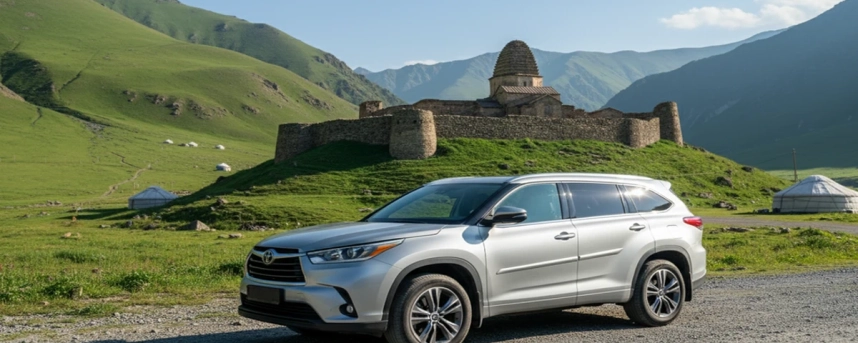
This unique 15th-century stone fortress lies in the Kara-Koyun Gorge at 3,200 meters above sea level. It once sheltered traders traveling from Kashgar to the Fergana Valley. Today, only mountains and grazing yaks surround it.
Logistics and Road
From Naryn to the turnoff, the road is asphalt. The last 15–20 km is gravel of varying quality. In dry weather, a careful sedan can pass, but after rain or snow (possible even in summer), it becomes challenging.
This is where high ground clearance matters. Stones, shallow streams, and uneven terrain require good protection and traction. We strongly recommend crossovers for this section.
Stop 3: Uzgen Architectural Complex
If you continue from Naryn to Osh via Kazarman Pass (4×4 only!) or via the M41 highway, you’ll reach Uzgen.
Uzgen was the second capital of the Karakhanids. Its main attractions are the mausoleums and the famous minaret, known for its intricate brick patterns — a masterpiece of medieval architecture.
Road Conditions

The Bishkek–Osh highway is one of the most scenic roads in the world, but technically demanding: long climbs, serpentines, tunnels.
A reliable cooling system and strong brakes are essential. At NomadCar, we perform deep brake inspections after every mountain trip.
For southern routes, we strongly recommend 4×4 vehicles such as Toyota 4Runner or Lexus GX470.
Stop 4: Sulayman-Too — The Soul of Osh
The final point of the southern route is Osh, a city older than Rome. Its heart is Sulayman-Too Mountain — Kyrgyzstan’s first UNESCO World Heritage site.
The mountain stands in the middle of the city. Inside are caves and a museum, and from the top you can see the Fergana Valley. According to legend, Prophet Solomon once prayed here.
Parking and Navigation
Traffic in Osh is more chaotic than in Bishkek. Parking near the mountain can be difficult on market days. We recommend using paid parking near the museum.
Alternative Route: Cholpon-Ata Petroglyphs
If you don’t have time to go south, explore the northern Silk Road route near Issyk-Kul.
In Cholpon-Ata, you’ll find an open-air museum of petroglyphs — thousands of stones with carvings of hunters, snow leopards, and camels. Some are over 4,000 years old.
Expert Tip
“The best time to visit is early morning or sunset. Low-angle sunlight makes the carvings stand out. At noon, many details disappear.”
Choosing the Right Vehicle: Your Partner on the Road
Road quality varies from perfect highways to washboard gravel. Choosing the right car is a strategic decision.

Route Type | Recommended Vehicle | Examples | Why
Light (Bishkek–Burana–Cholpon-Ata–Karakol)
Economy/Comfort | Hyundai Accent, Toyota Camry
All asphalt, focus on fuel economy and comfort.
Explorer (Naryn, Tash-Rabat, Son-Kul)
Crossover/SUV | Toyota RAV4, Highlander
Need 180+ mm clearance and AWD.
Expedition (Kazarman, Kel-Suu, remote passes)
Full SUV | Land Cruiser, Lexus LX
Frame construction, low gears, strong suspension.
All our cars are equipped with high-quality seasonal tires. We never compromise on safety.
Practical Tips for Road Travelers
Fuel
Use major fuel chains (Gazprom, Bishkek Petroleum, Red Petroleum). In remote areas, range is critical. If you see a station before mountains — fill up.
Connectivity & Navigation
Internet is unreliable in the mountains. Download offline maps (Maps.me, 2GIS).
Documents
You need a passport and driver’s license. We provide fast, transparent contracts with no hidden fees.
Driving Culture
Livestock often walks on roads. Be especially careful at dusk. A flock around a bend is normal here.
Planning Distances and Time
In the mountains, average speed is 40–60 km/h. A 300 km drive may take 6–7 hours.
We can help you plan realistic schedules so you enjoy history instead of fighting fatigue.
Frequently Asked Questions
Can I return the car in another city (e.g., pick up in Bishkek, drop off in Osh)?
Yes, with prior arrangement. Discuss it with our manager when booking.
What if the car breaks down in the mountains?
We provide 24/7 support. We will guide you to the nearest service or arrange assistance or replacement.
Is standard insurance enough for Tash-Rabat?
Yes, our insurance covers main tourist routes, including gravel roads, if usage rules are followed. All conditions are explained before signing.
Final Thoughts
Driving the Silk Road means touching the history that shaped our world. It changes how you see time and space. The right car makes this journey safe and comfortable.
At NomadCar, we are ready to be your reliable partner. Choose your route, book the right vehicle on our website, and discover Kyrgyzstan at its best.
The road is waiting. Safe travels!


