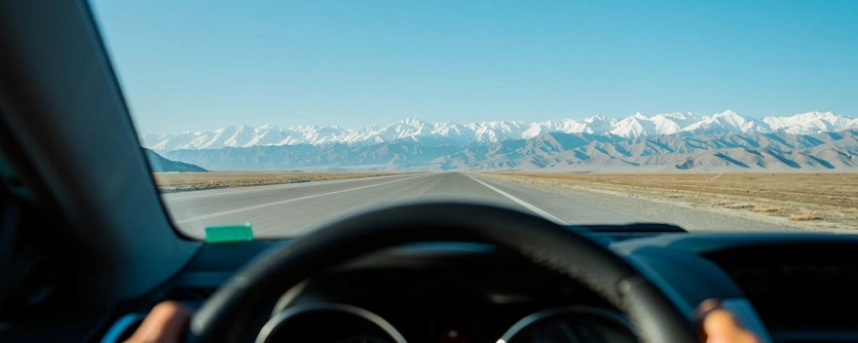
Hello, my name is Anton Shishkin. For over five years in the car rental industry in Bishkek, I have helped more than 2,000 clients choose the perfect vehicle for traveling across Kyrgyzstan. And I know that before their trip, many of them ask the same question:
“How difficult and safe is it to drive in Kyrgyzstan?”
The dream of freely traveling along scenic mountain passes often clashes with stories about local roads, driving habits, and traffic police.
The purpose of this article is to give you an honest, complete, and practical picture. At NomadCar, we want your driving experience to bring only pleasure. That’s why we’ve gathered all our experience so you can feel confident on any road in our beautiful country.
Golden Rules of Driving in Kyrgyzstan: What’s Different from Standard Traffic Laws?
At first glance, Kyrgyzstan’s traffic rules are similar to those in most CIS countries. However, there are local specifics that can help you avoid fines and unpleasant situations.
Speed Limits: Where and How Fast You Can Drive
The basic limits are easy to remember:
-
In cities: 60 km/h
-
Outside cities: 90 km/h
-
On highways: 110 km/h
Pay special attention to additional speed signs near towns, villages, and roadworks. Speeding is the most common violation, so it’s best to stay within limits.
Overtaking and Intersections: Local Driving Style
Driving in Kyrgyzstan is generally more dynamic and less formal than in Europe. Some drivers may not use turn signals or may change lanes suddenly.
Our advice:
-
Keep a safe distance
-
Drive predictably
-
Follow official rules, not other drivers’ behavior
At intersections, especially without traffic lights, always give way to vehicles already in the roundabout or coming from the right.
Do You Need an International Driving Permit (IDP)?
This is a very common question.
Under the Vienna Convention on Road Traffic (which includes Russia and most European countries), you can legally drive in Kyrgyzstan with your national license.
However, we strongly recommend having an International Driving Permit (IDP). It’s not mandatory, but it makes communication with police much easier.
The Main Challenge: Driving Safely in the Mountains
Kyrgyzstan is 90% mountainous, and the most beautiful routes run through mountain passes. Driving here requires both a reliable car and proper skills.

On mountain roads, your best assistant is not the brake — it’s the right gear.
Driving Technique on Serpentines
A common mistake is using brakes constantly on downhill roads. This causes overheating and possible brake failure.
Correct technique:
-
Use engine braking
-
On automatic: use “L”, “2”, or manual mode
-
On manual: descend in the same gear you would use for climbing
This gives you better control and protects your brakes.
Seasonal Road Closures
In winter and early spring, high mountain passes (such as Too-Ashuu on the Bishkek–Osh road or the road to Son-Kul Lake) may be closed due to snow and avalanches.
Before traveling, check official updates from the Ministry of Transport of Kyrgyzstan.
Expert Tip
Anton Shishkin:
“Never blindly trust navigation apps in the mountains. What looks like a short route may be a difficult gravel pass unsuitable for sedans. If in doubt, ask us — we’ll suggest the safest and most scenic route.”
Why You Need an SUV in the Mountains
For destinations like Kel-Suu, Son-Kul, or Altyn-Arashan, a regular car is not enough.
You need:
-
High ground clearance
-
All-wheel drive
-
Strong suspension
An SUV is not about comfort — it’s about safety.
Meeting the Traffic Police (GUOBDD): How to Communicate
Being stopped by traffic police is normal. The key is to know your rights and stay polite.
Legal Reasons for Stopping
Officers may stop you for:
-
Visible violations
-
Official inspection campaigns

Random checks are becoming less common.
Required Documents
Always carry:
-
Driver’s license (plus IDP if available)
-
Vehicle registration
-
Insurance policy
We provide all documents with our rental cars.
How to Avoid Problems
-
Stay calm and polite
-
Greet the officer
-
Stay in the car unless asked to exit
-
Hand over documents
If you disagree with a violation, politely ask for proof.
Main Traffic Fines in Kyrgyzstan (2025)
| Violation | Fine (KGS) | Notes |
|---|---|---|
| Speeding 10–20 km/h | 1,000 | |
| Speeding 20–40 km/h | 3,000 | |
| No seat belt | 1,000 | Driver & passengers |
| Phone use while driving | 3,000 | Without hands-free |
Important Practical Tips
Fuel Stations
In Bishkek and on major routes, fuel quality is good (“Gazprom”, “Bishkek Petroleum”).
In mountain areas, stations are rare — always fill up in advance.
Parking in Bishkek
Many central areas are paid. Look for meters or attendants. Towing is common for illegal parking.
Animals on the Road
Outside cities, cows, sheep, and horses often cross roads — especially at night. Slow down near grazing areas.

Outside cities, animals always have priority.
Key Takeaways for Tourists
Driving in Kyrgyzstan is an unforgettable experience that gives you real freedom.
Yes, there are local specifics, but they shouldn’t scare you. The main things are:
-
Be informed
-
Be prepared
-
Have a reliable partner
With a well-maintained car from NomadCar and our 24/7 support, you’ll feel confident anywhere.
We don’t just rent cars — we give you access to discovery and adventure.
Frequently Asked Questions
Are roads really that bad in Kyrgyzstan?
Road quality varies. Main highways (like Bishkek–Issyk-Kul) are in good condition. Mountain roads are often gravel. We always inform clients honestly and select suitable vehicles.
What’s the best car for mountain trips?
Definitely an SUV. All-wheel drive, high clearance, and strong suspension are essential. For families and groups, models like Toyota Sequoia or Lexus LX470 are ideal.
What if I have a breakdown or accident far from the city?
First — don’t panic. Contact our 24/7 support immediately.
We will:
-
Guide you step by step
-
Arrange roadside assistance
-
Provide a replacement vehicle if needed
All our cars are insured, and we fully support our clients in any situation.


